
Why modernization breaks down
Modernization looks like a technology topic, but it behaves like a leadership topic. It introduces risk, disrupts operating rhythm, and forces tradeoffs across teams. When leadership does not define the tradeoffs, teams make them by default. Those default decisions usually optimize for local safety, not enterprise outcomes.
Leaders also tend to fund modernization in large batches. They approve a program, create a roadmap, then assume delivery will self-correct. Modernization does not self-correct. It requires active steering because the work surfaces hidden dependencies, weak ownership, and mismatched incentives.
The 10 modernization mistakes leaders repeat
1. Funding activity instead of outcomes
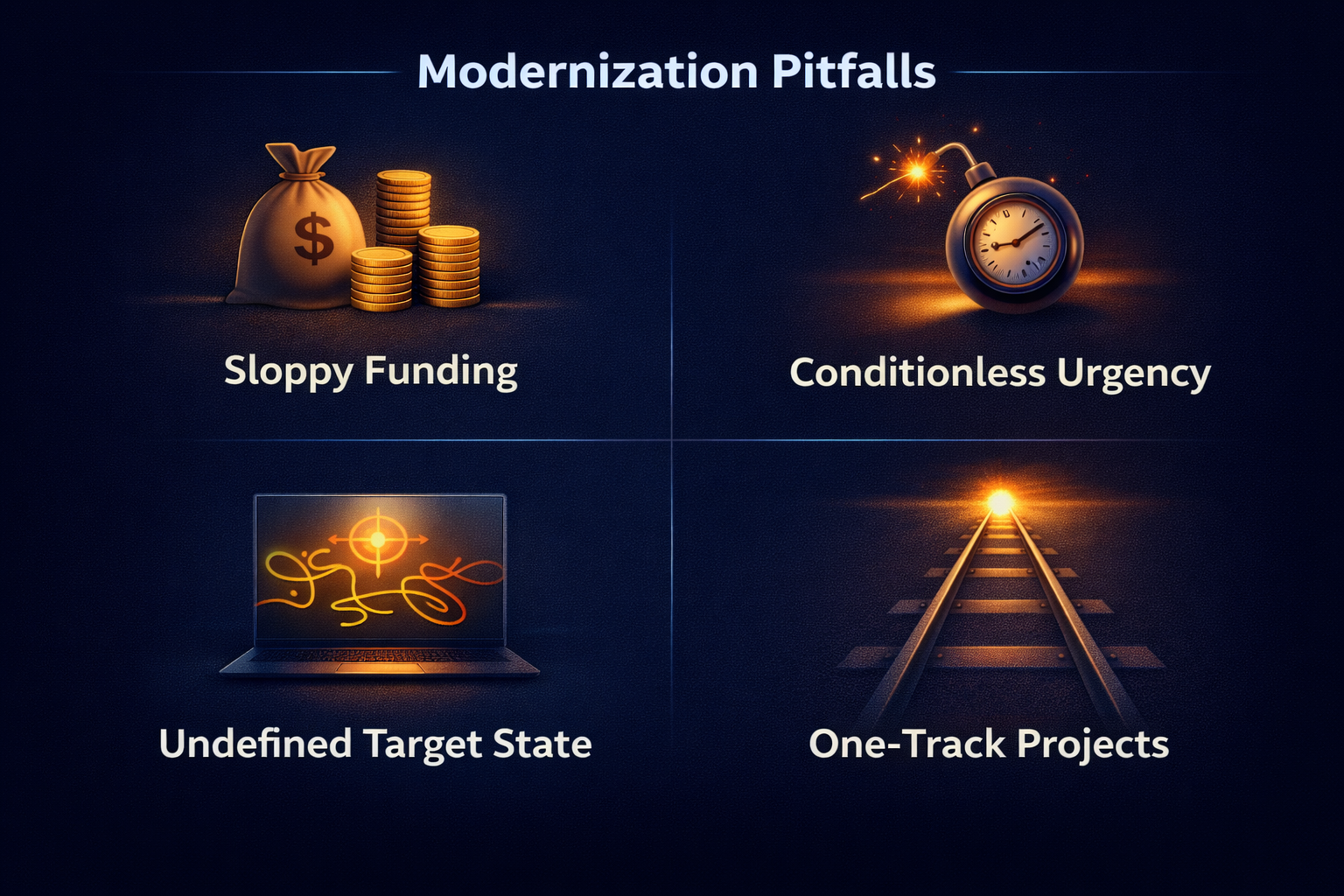
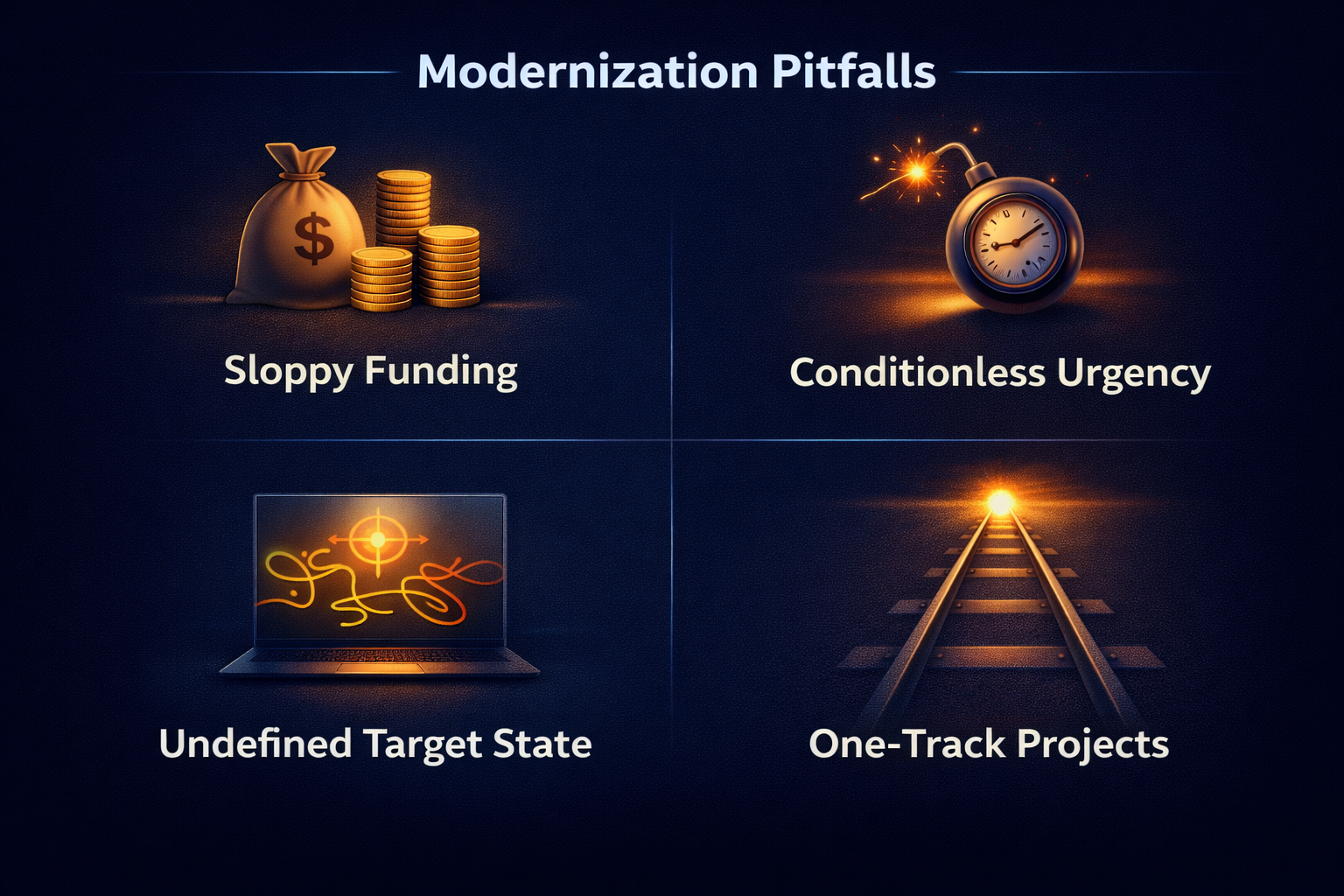
Leaders approve modernization work because it sounds responsible. Teams then measure progress by tasks completed. The business only cares about outcomes. If you cannot state the outcome in one sentence, the work is not ready for funding.
- Bad. “Migrate to microservices.”
- Better. “Reduce release lead time by 50% while maintaining uptime.”
2. Treating modernization as a one-time project
Modernization changes how you operate. It affects incident response, release governance, vendor management, and ownership. If you treat it like a project, it ends before the operating model stabilizes. That is how technical debt returns within a year.
3. Skipping constraints
Constraints are not limitations. They are protection. Without constraints, teams expand scope to reduce anxiety. The result is slower delivery and higher risk.
- Budget band. What is real.
- Risk tolerance. What is acceptable.
- Time. What deadline matters and why.
- Reliability and security. What must not regress.
4. Allowing committees to replace ownership
Committees feel safe. They also slow decisions and dilute accountability. Every major platform and domain needs a single accountable owner. The owner does not do all work. The owner decides and answers for outcomes.
5. Modernizing the wrong layer first
Teams often start with visible layers. New UI. New tooling. New cloud platform. Those changes do not fix the hard parts like data quality, integration reliability, and release discipline. Start where failure and cost concentrate.
- If outages dominate, start with reliability practices and observability.
- If delivery is slow, start with release flow, dependencies, and environment consistency.
- If cost is high, start with architecture hot spots and vendor contracts.
6. Buying tools before changing behavior
Tools do not create discipline. Leadership does. New platforms often increase cost because teams keep old systems running while they learn the new ones. Require adoption proof, ownership, and an exit path before you expand tooling.
7. Ignoring operational readiness
Modernization must ship into production. If you do not define operating cadence, ownership, and incident response, the new environment becomes fragile. Fragile systems force teams back into manual work and approvals.
8. Overloading teams with parallel initiatives
Modernization competes with features, regulatory work, and production support. When leaders run too many initiatives in parallel, teams context switch and quality drops. Delivery slows, then leaders add more governance, which slows delivery further.
9. Leaving vendor leverage unmanaged
Modernization often increases vendor dependence. If leaders do not define commercial strategy and renewal decision criteria, vendors set the agenda. You then pay more for less flexibility.
10. Waiting too long to stop or reset
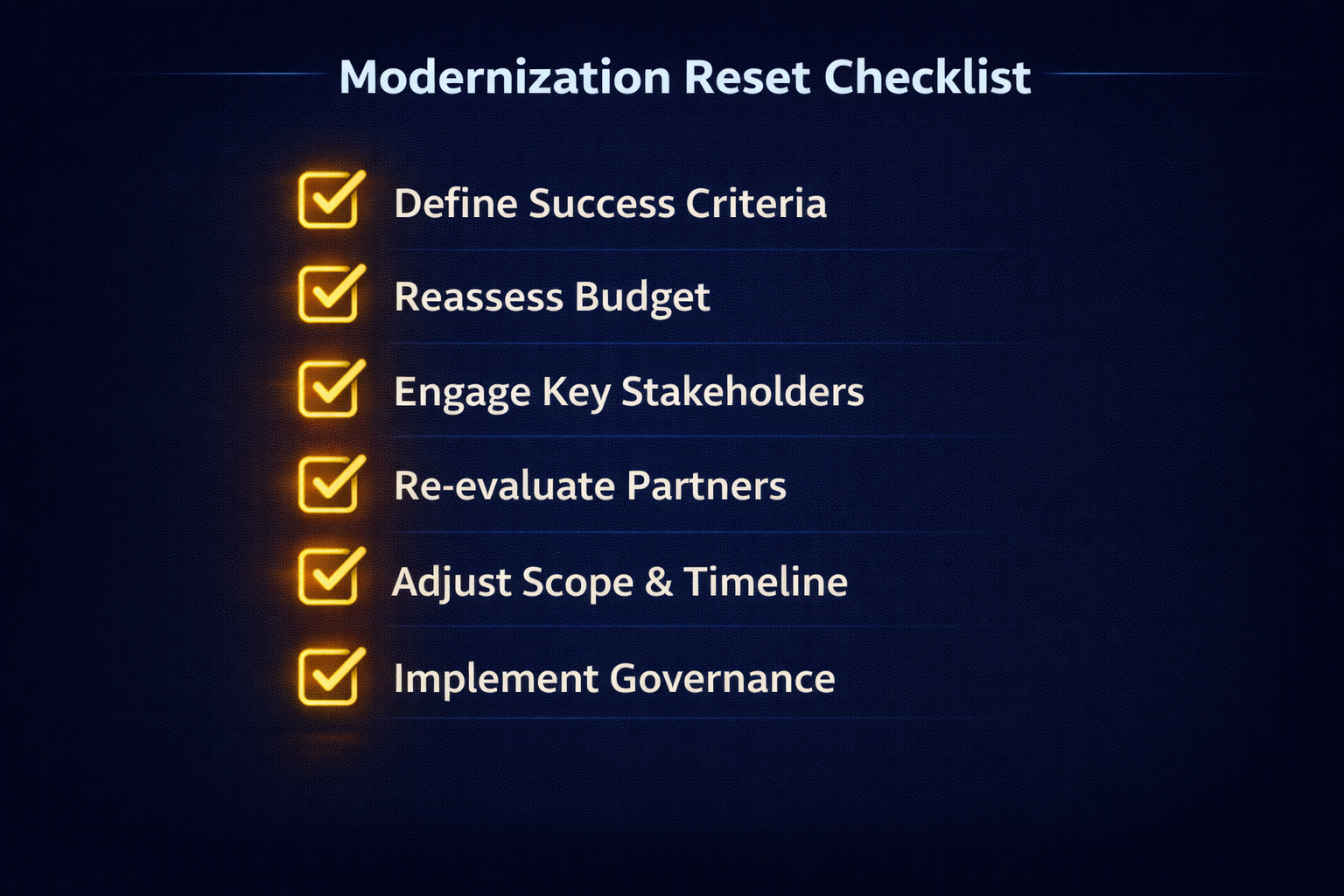
Leaders hesitate to stop modernization work because sunk cost feels painful. Sunk cost is already gone. The cost you can control is the future cost. Run a 60 to 90 day proof cycle. If outcomes do not move, reset scope and ownership.
Guardrails that prevent these mistakes
You do not need a long governance manual. You need a few guardrails leaders repeat every week. Use these guardrails to keep modernization focused and safe.
Guardrail 1. Outcome statement required for funding
- One sentence outcome.
- Baseline metric and target metric.
- Owner and review cadence.
Guardrail 2. One owner per domain and platform
Assign an accountable owner for each major capability area. Examples: customer identity, payments, analytics, integration, infrastructure platform. The owner owns delivery and operating results.
Guardrail 3. Exit criteria for every investment
Modernization creates overlap. Overlap drives cost. Every investment needs an exit plan for what gets retired and when. If you cannot retire anything, the program becomes additive cost.
Guardrail 4. Weekly steering with a simple dashboard
Modernization fails in slow motion. Weekly steering catches drift early. Keep the dashboard simple.
- Outcome progress.
- Top risks and blockers.
- Decision requests.
- Spend and forecast.
- Operational health. Incidents, performance, security issues.
These guardrails work best when they stay tied to a broader execution model. Teams that pair modernization with a tighter initiative reset discipline and a clearer strategy decision model usually regain momentum faster.
How to decide what to modernize first
Leaders often ask teams for a target architecture. That request triggers long design cycles and tool debates. Use a simpler method. Modernize where the business pays the most today.
Start with where risk concentrates
- Repeated incidents and escalations.
- Security findings that recur.
- Compliance gaps that create manual controls.
Then modernize where time is lost
- Release approvals and change windows.
- Integration dependencies that require coordination across teams.
- Environment drift between dev, test, and production.
Then modernize where unit cost is high
- Vendor contracts with low adoption.
- Duplicated platforms and tools.
- Custom builds where commodity solutions fit.
Decision checkpoints leaders should use
Use these questions in steering meetings to keep modernization tight. If you cannot answer a question clearly, pause expansion and fix ownership and scope.
- What outcome moves in the next 60 to 90 days.
- What risk are we taking, and who owns it.
- What gets retired, and when.
- What is the operating cadence once this ships.
- What decision do you need from leadership this week.
What success looks like in 90 days
Modernization should create visible improvements quickly. You want early proof to build confidence and protect focus.
- Clear outcome statements and owners for every funded track.
- Reduced initiative count and fewer competing priorities.
- Shorter delivery cycles and fewer emergency changes.
- Lower operational noise. Fewer escalations and faster recovery.
- A visible retirement plan for legacy systems and contracts.
Frequently Asked Questions
Why do modernization programs fail so often?
Modernization programs fail when leaders fund activity instead of outcomes, leave ownership unclear, and allow scope to expand without clear constraints or exit criteria.
What should leaders define before funding modernization work?
Leaders should define one measurable outcome, clear constraints, decision rights, accountable owners, and what legacy cost or process will be retired as the work progresses.
How do leaders decide what to modernize first?
Start where business pain concentrates today. Focus first on repeated incidents, recurring security or compliance gaps, delivery bottlenecks, and areas with high unit cost or duplicated tooling.
What guardrails keep modernization from turning into endless scope?
Use a short set of guardrails. Require an outcome statement for funding, assign one owner per domain and platform, define exit criteria for every investment, and run a weekly steering cadence with simple metrics.
What should success look like in the first 90 days?
Success should show up as clearer ownership, fewer competing priorities, faster delivery cycles, lower operational noise, and a visible retirement plan for legacy systems or contracts.
Need a modernization plan leaders can run
If your modernization work feels scattered, vendors are driving decisions, or delivery has slowed, a short working session can surface the real constraints, reset ownership, and produce a 30-day execution plan with clear outcomes and guardrails.
Book a consultation